
Global Voice Direct vs RingCentral: Which Business Phone System Is Right for Your Business?
Compare pricing, AI features, business phone service capabilities, CRM integrations, mobile apps, business texting, AI voice assistants, startup-friendly features, and business growth tools — in one objective, data-driven breakdown.
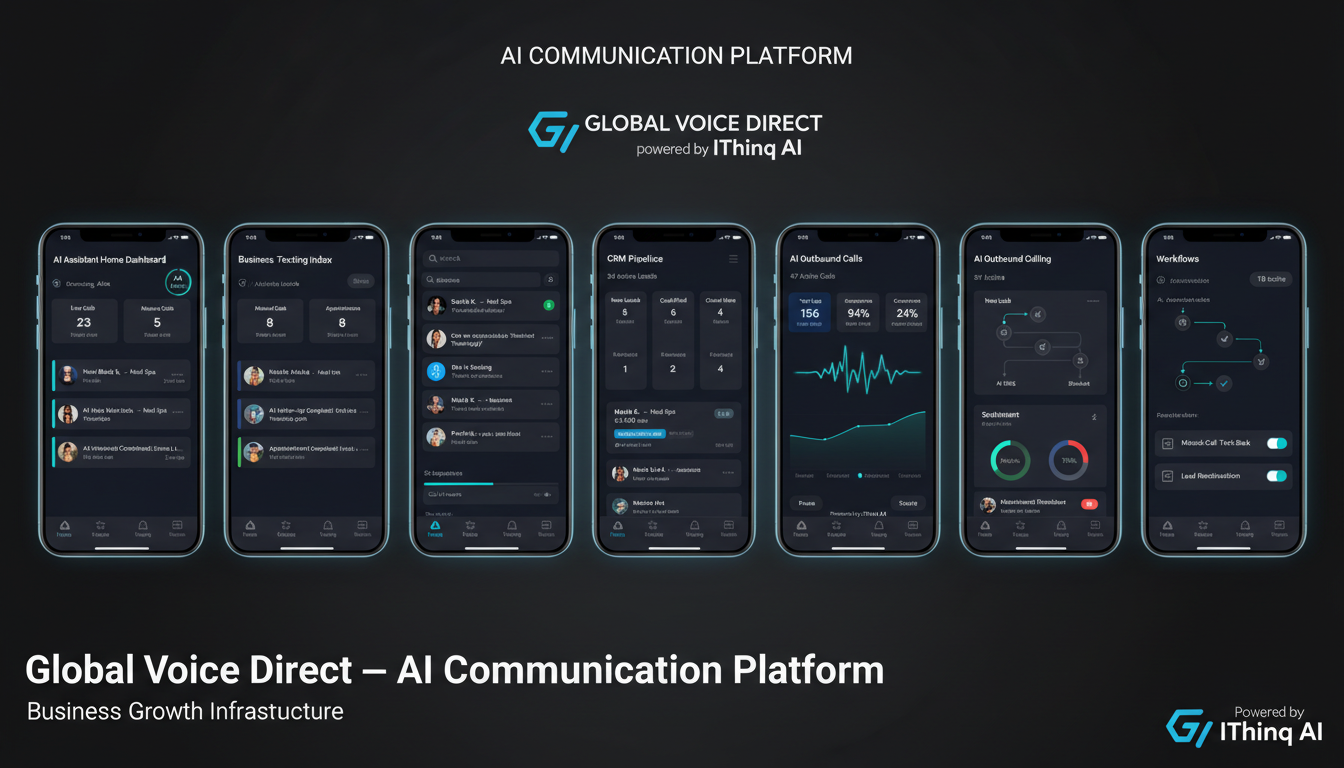
Why Businesses Are Looking Beyond Traditional VoIP Providers
For two decades, choosing a business phone system meant choosing between lines, extensions, and minutes. In 2026, that framing is outdated. The fastest-growing small businesses now expect their phone system to also answer calls, qualify leads, follow up automatically, and connect directly to their customer records.
Short answer: Traditional VoIP providers like RingCentral were built primarily for enterprise communications. Newer AI-native platforms like Global Voice Direct combine business phone service, an AI receptionist, business texting, CRM workflows, and growth infrastructure into a single system — which is why many startups and small businesses now compare the two before committing.
The pain points driving this shift are consistent across industries:
- Rising costs: Per-seat enterprise pricing adds up quickly as teams grow, and advanced features often sit behind higher tiers.
- Complex implementations: Migrations, number porting, and IT-heavy setups slow down small teams that need to be live this week, not next quarter.
- Limited AI functionality: Many legacy systems bolt AI onto the edges rather than building it into how calls are answered and routed.
- Disconnected tools: A phone system that doesn’t talk to your CRM, texting, and follow-up automation creates manual busywork.
- No path to automation: Growing businesses want to capture every lead automatically — not staff a desk to catch every ring.
Modern businesses increasingly want one platform that delivers communication, automation, AI, texting, CRM, and growth infrastructure together — rather than stitching five vendors into a fragile workflow.
Consider how the typical small business actually loses money on the phone. A prospect calls during a busy hour, reaches voicemail, hangs up, and calls the next provider on their list. The lead is gone before anyone even knew it existed. Studies of inbound calling consistently show that a large share of callers will not leave a voicemail and will not call back. For a contractor, a med spa, or an insurance agency, a single missed call can represent hundreds or thousands of dollars in lost lifetime value. A traditional phone system simply records the miss; an AI-native system answers it, qualifies it, and books it.
This is the gap that has opened up between legacy VoIP and the newer generation of platforms. RingCentral, Nextiva, Grasshopper, OpenPhone, and Dialpad all grew up solving the connectivity problem — getting voice reliably from one place to another at scale. That problem is largely solved. The frontier now is what happens during and after the call: whether the right person (or AI) answers, whether the lead is captured, whether the follow-up happens automatically, and whether all of it flows into a system that helps the business grow. That reframing is why a comparison like Global Voice Direct vs RingCentral looks so different from a comparison between two legacy providers.
It also explains why so many searches now combine “RingCentral alternative” with phrases like “AI receptionist,” “without porting,” and “for small business.” Buyers are not just shopping for a cheaper dial tone — they are shopping for an outcome: more captured leads, less manual work, and a communication system that scales with them.
Quick Comparison Snapshot
A side-by-side look at how Global Voice Direct (powered by IThinq AI) and RingCentral compare across the capabilities that matter most to modern small businesses.
| Capability | Global Voice Direct | RingCentral |
|---|---|---|
| Business Phone Service | ✓ Yes | ✓ Yes |
| AI Receptionist | ✓ Built-in | ~ Limited / tiered |
| AI Voice Assistant | ✓ Yes | ~ Add-on |
| Business Texting | ✓ Yes | ✓ Yes |
| CRM | ✓ Built-in workflows | ~ Integrations |
| Call Recording | ✓ Yes | ✓ Yes |
| Mobile App | ✓ Yes | ✓ Yes |
| Keep Existing Number | ✓ Yes | ✓ Port |
| Use Existing Number (no porting) | ✓ Yes | ✗ Requires porting |
| AI Outbound Calling | ✓ Yes | ~ Limited |
| AI Follow-Up Automation | ✓ Yes | ✗ Not native |
| Missed Call Text Back | ✓ Yes | ~ Via setup |
| Business Credit Reporting Opportunities* | ✓ Available | ✗ No |
| Vendor Account Options* | ✓ Available | ✗ No |
| Funding Partner Access* | ✓ Via partners | ✗ No |
| Startup Focus | ✓ Core focus | ~ Enterprise focus |
| International Numbers | ✓ Yes | ✓ Yes |
| 24/7 Support | ✓ Yes | ✓ Yes |
| Business Growth Infrastructure | ✓ Yes | ✗ Communications only |
*Vendor account, business credit reporting, and funding-related features are offered through Global Voice Direct partners and ecosystem programs. Availability and eligibility vary. Global Voice Direct is not a lender and does not guarantee credit, funding, or financing outcomes. Feature parity changes over time — verify current capabilities with each provider.
How to read this comparison
A snapshot table is a starting point, not a verdict. A checkmark tells you a capability exists; it does not tell you how deep, how easy to use, or how well-integrated that capability is. RingCentral, for example, can absolutely send business texts and offers AI features — but the practical experience of those features, and which plan tier they live in, differs from a platform where the same capabilities are core and bundled. Conversely, “✓” on the Global Voice Direct column reflects features designed to work together out of the box, which is a different value proposition than a feature you have to assemble from add-ons and third-party integrations.
For that reason, treat the rest of this page as the real comparison. The sections below explain what each capability means in day-to-day operation, where each platform genuinely excels, and which kind of business each one is built to serve. The goal is to help you make an informed decision — not to declare a single universal winner, because no honest comparison of business phone systems can do that.
What Makes Global Voice Direct Different?
Most phone companies sell phone lines, extensions, and minutes. Global Voice Direct delivers a complete operating system for modern business communication — combining business phone service, AI voice, CRM workflows, automation, and startup-focused growth tools in one platform.
RingCentral is, at its heart, a communications company — and a capable one. Global Voice Direct, powered by IThinq AI, the artificial intelligence technology powering its communication infrastructure, is built around a different premise: that the phone is a growth engine, not just a utility.
Business Communication
Full-featured cloud phone service, business texting, call recording, and a mobile app for calls anywhere.
AI Voice & Receptionist
An AI receptionist answers, qualifies, and routes calls — and an AI voice assistant handles conversations around the clock.
CRM Workflows
Built-in CRM and automation so every call, text, and lead is captured and followed up automatically.
Startup Credibility
A professional phone presence and business identity tools that help new companies look established from day one.
Vendor Account Ecosystem
Access to vendor account opportunities through partners — one of the building blocks businesses use to establish themselves.
AI Outbound Calling
Automated outbound calling for follow-ups, reminders, and lead engagement without adding headcount.
Core positioning: Global Voice Direct is “The Operating System For Modern Business Communication” — designed for businesses that want communication, automation, and growth infrastructure to live in one place.
The distinction matters most in the day-to-day. With a traditional provider, a phone system is something you configure once and then mostly forget about until something breaks. With Global Voice Direct, the phone system is an active participant in operations: it greets callers, asks qualifying questions, books appointments, texts the people you missed, updates customer records, and triggers the next step automatically. The phone stops being a cost center and starts behaving like a junior team member who never sleeps.
None of this means RingCentral is a poor product. For a large organization with a switchboard, hundreds of extensions, contact-center agents, and an internal IT team, RingCentral’s depth and maturity are real advantages. The point of this comparison is fit, not winners and losers in the abstract. The question worth asking is simple: are you running an enterprise communications operation, or are you a growing business that needs the phone to actively help you capture and convert demand? Your answer largely determines which platform is right for you.
Use Your Existing Number — No Porting Required
One of the biggest reasons businesses delay switching phone systems is the fear of porting their number and losing calls during the transition. Global Voice Direct, powered by IThinq AI, removes that barrier entirely.
You can deploy an AI phone assistant using virtually any number you already have:
- ✓Your existing business number — keep the line your customers already know.
- ✓Your existing cell phone number — turn a personal mobile into an AI-powered business line.
- ✓Your existing VoIP number — layer AI on top of the VoIP service you already use.
- ✓An international number — establish presence in multiple markets.
- ✓A new number from Global Voice Direct — start fresh with a dedicated business line.
This flexibility is genuinely uncommon in the industry. It eliminates complicated migrations, removes downtime risk, and lets a business go live with an AI receptionist in a fraction of the time a traditional porting process requires.
AI Capabilities Comparison
Both platforms invest in AI, but they approach it differently. RingCentral layers AI onto an enterprise communications suite. Global Voice Direct, with IThinq AI, treats AI as the core of how calls are answered, qualified, and followed up.
| AI Capability | Global Voice Direct + IThinq AI | RingCentral AI |
|---|---|---|
| AI Receptionist | ✓ Core feature | ~ Tiered / limited |
| AI Voice Assistant | ✓ Yes | ~ Add-on |
| Lead Qualification | ✓ Automated | ✗ Not native |
| Appointment Scheduling | ✓ Yes | ~ Via integration |
| Call Summaries | ✓ Yes | ✓ Yes |
| Call Analytics | ✓ Yes | ✓ Yes |
| Outbound AI Calling | ✓ Yes | ✗ Limited |
| Customer Service Automation | ✓ Yes | ~ Enterprise tiers |
| CRM Automation | ✓ Built-in | ~ Integrations |
AI feature sets evolve rapidly across both platforms. Confirm current capabilities directly with each provider before purchasing.
The practical difference: for a small business, an AI receptionist that answers every call, qualifies the lead, books the appointment, and logs it to the CRM automatically is the difference between capturing revenue and missing it. To understand the broader landscape of conversational AI, resources from organizations like OpenAI offer useful context on how large language models power modern voice assistants.
It helps to think about AI in two layers. The first layer is assistive AI — features that help a human do their job faster, like automatic call summaries, transcription, and sentiment analysis. Both platforms offer meaningful capabilities here. The second layer is agentic AI — software that actually does the job in place of a human, answering the call, holding a real conversation, qualifying the caller, and taking action. This second layer is where Global Voice Direct, powered by IThinq AI, is built to lead, because the AI receptionist and AI voice assistant are designed as front-line workers rather than back-office helpers.
For a business owner, the implications are concrete. An assistive-AI phone system still requires someone to be available to answer; it just makes that person more efficient afterward. An agentic-AI phone system can run the front desk on its own when no one is free — at 9 p.m., on a Saturday, or during the lunch rush. For startups and lean teams without a dedicated receptionist, that capability is often the single biggest reason to switch. AI outbound calling extends the same logic in the other direction: instead of a salesperson manually dialing through a follow-up list, the AI places the calls, confirms appointments, and surfaces only the conversations that need a human.
Built For Startups
A professional phone system is one of the first assets a business establishes when building credibility. Global Voice Direct is designed around the needs of startups and small businesses — pairing a professional communication presence with automation and growth tools that help new companies operate like established ones.
Where enterprise platforms assume you already have an IT department and an established footprint, Global Voice Direct assumes you’re building from the ground up.
Vendor Account Opportunities*
Access vendor account programs through partners — part of how many businesses establish their presence and operating history.
Business Phone Number
A dedicated business line separates you from a personal cell and signals legitimacy to customers and partners.
Professional Presence
An AI receptionist and polished call handling make a two-person startup sound like a real operation.
AI Receptionist
Never miss a lead. The AI answers, qualifies, and routes calls even when you’re heads-down on the work.
Automation
Missed-call text-back, follow-ups, and CRM logging happen automatically — no extra staff required.
Scalability
Start lean and add numbers, users, and automation as you grow, without re-platforming.
*Vendor account and business-building features are provided through partners and ecosystem programs; eligibility and availability vary. Global Voice Direct is not a lender, credit-repair organization, or financial advisor, and does not guarantee funding, credit approval, or specific business credit outcomes. For authoritative consumer and small-business communications information, see the FCC.
RingCentral vs Global Voice Direct: Pricing Philosophy
The two platforms price toward different goals. RingCentral focuses primarily on communications, with tiers that add features and seats. Global Voice Direct prices around communications plus automation, AI, and business growth tools bundled together.
| Pricing Dimension | Global Voice Direct | RingCentral |
|---|---|---|
| What you’re paying for | Communication + AI + automation + growth tools | Communications suite |
| AI receptionist included | ✓ Yes | Often higher tiers |
| CRM workflows included | ✓ Yes | Add-ons / integrations |
| Startup-friendly entry | ✓ Yes | Enterprise-oriented |
| Growth infrastructure | ✓ Included focus | ✗ Not offered |
Pricing changes frequently. Verify current pricing directly with RingCentral. The table above compares pricing philosophy and bundled value, not specific dollar figures.
The smartest way to compare cost between these platforms is not the sticker price of a single line — it is the total cost to achieve the outcome you actually want. If your goal is simply to make and receive calls, almost any provider can do that, and price differences come down to seats and features. But if your goal is to never miss a lead, to follow up automatically, and to keep customer data organized, the real comparison is the cost of one platform that includes those capabilities versus the cost of a base phone plan plus an AI add-on, plus a separate CRM, plus a separate texting or follow-up tool, plus the staff time to keep them connected.
When you add up that stack, the bundled approach often wins on both price and simplicity. There is also a hidden cost in fragmentation: every additional vendor is another login, another bill, another integration that can break, and another support line to call when something goes wrong. Consolidating communication, AI, CRM, and automation into a single platform reduces that operational overhead — which for a small team is frequently worth more than any line-item savings. As always, confirm the current published pricing and plan inclusions with each provider directly, since both companies update their tiers regularly.
Which Platform Is Right For You?
No single phone system is best for everyone. Here’s a balanced view of where each option genuinely shines.
Built for the Enterprise
- A large enterprise with hundreds or thousands of seats
- An organization with a dedicated internal IT team to manage deployment
- A traditional corporate environment with established procurement and complex telephony needs
- A company that needs deep, mature integrations across a large legacy software stack
Building & Growing
- A startup or entrepreneur establishing professional credibility
- A contractor, insurance agency, or med spa that can’t afford to miss a call
- A local service business that wants AI to answer and qualify leads 24/7
- A growing company that wants communication, AI, CRM, and growth tools in one platform
If you still aren’t sure, a useful tiebreaker is to look at where your team spends its frustration. If your pain is managing a large, complex phone deployment across many departments and you have IT resources to do it, an enterprise platform earns its keep. If your pain is missed calls, slow follow-up, scattered customer notes, and not enough hours in the day, an AI-native growth platform is built to solve exactly that. Most startups and small businesses fall squarely into the second group — which is why this comparison so often lands in Global Voice Direct’s favor for that audience, while remaining genuinely balanced about who RingCentral serves best.
Frequently Asked Questions
Common questions about Global Voice Direct vs RingCentral, AI business phone systems, and switching providers.
Yes. Global Voice Direct is a strong RingCentral alternative for startups and small businesses, because it combines business phone service with a built-in AI receptionist, AI voice assistant, CRM workflows, business texting, and growth infrastructure in one platform — rather than offering communications alone.
RingCentral is primarily an enterprise communications platform. Global Voice Direct, powered by IThinq AI, is an AI-native business communication operating system that bundles automation, an AI receptionist, CRM, and startup-focused growth tools alongside its phone service.
Yes. Global Voice Direct can deploy an AI phone assistant on your existing business number, your existing cell phone number, your existing VoIP number, an international number, or a brand-new number it provides — often without the complicated porting process traditional providers require.
Yes. An AI receptionist is a core feature. It answers calls, qualifies leads, routes callers, and can book appointments automatically — so you never miss a potential customer, even after hours.
An AI business phone system uses artificial intelligence to answer and route calls, qualify leads, send automated follow-ups, summarize conversations, and connect activity to a CRM — going far beyond the basic call routing of a traditional VoIP phone.
Pricing for both platforms changes frequently, so you should verify current pricing directly with each provider. The key difference is value: Global Voice Direct bundles AI, automation, and CRM workflows into its plans, where comparable capabilities often sit in higher RingCentral tiers or as add-ons.
RingCentral offers AI features, but its AI receptionist and assistant capabilities are typically tiered or positioned as add-ons within an enterprise suite. Global Voice Direct treats the AI receptionist as a core, built-in capability.
Yes. You can keep and use your existing number. Global Voice Direct can layer its AI phone assistant on top of the number your customers already know, avoiding downtime and lost calls during a switch.
An AI voice assistant is software that holds natural spoken conversations with callers — answering questions, capturing details, qualifying leads, and handling routine requests automatically, 24/7, without a human on the line.
Yes. It’s built with startups in mind, pairing a professional business phone presence and AI receptionist with automation and growth tools that help new companies build credibility and capture every lead from day one.
A vendor account is a business relationship with a supplier that some businesses use as part of establishing their operating presence. Global Voice Direct offers vendor account opportunities through partners and ecosystem programs; availability and eligibility vary.
No. Global Voice Direct is not a lender and does not guarantee funding, credit approval, or specific business credit outcomes. It may provide access to funding partners and business-building tools, but any financing decisions rest with third-party providers and your own qualifications.
Yes. Built-in CRM workflows capture calls, texts, and leads automatically and trigger follow-up automation — so your communication and customer data live in the same place instead of being scattered across tools.
Yes. Business texting is included, along with missed-call text-back automation so callers who don’t reach you automatically receive a text to keep the conversation going.
Yes. Global Voice Direct offers a mobile app so you can make and take business calls, send texts, and manage your communications from anywhere, separate from your personal number.
AI outbound calling uses an AI voice assistant to place automated calls for follow-ups, reminders, appointment confirmations, and lead engagement — scaling outreach without adding staff.
Yes. Med spas, contractors, insurance agencies, and local service businesses are an ideal fit, because the AI receptionist captures and qualifies leads around the clock while staff focus on serving clients.
Because Global Voice Direct can use your existing number without a complicated porting process, many businesses go live quickly — far faster than a traditional migration that involves porting and IT configuration.
Yes. International numbers are available, allowing businesses to establish a local presence in multiple markets from a single platform.
Missed-call text-back automatically sends a text message to anyone whose call you miss, instantly re-opening the conversation so you don’t lose the lead to a competitor who answered.
Yes. Call recording, AI call summaries, and call analytics are available so you can review conversations, coach your team, and understand call performance.
Yes. It’s a cloud-based VoIP business phone service, meaning there’s no on-premise hardware to maintain and you can manage everything from the app and dashboard.
Large enterprises, organizations with dedicated internal IT teams, and traditional corporate environments with complex legacy telephony requirements may find RingCentral’s enterprise suite a better fit.
Startups, entrepreneurs, contractors, insurance agencies, med spas, local service businesses, and growing companies that want AI, automation, CRM, and communications in one growth-focused platform are the strongest fit for Global Voice Direct.
You can choose a package at app.globalvoicedirect.com or call 877-308-5803 to speak with the team about which setup fits your business.
Learn More About Global Voice Direct
Dive deeper into the features and capabilities behind the platform.
Ready For More Than Just A Phone System?
Global Voice Direct combines business communications, AI automation, business texting, CRM workflows, AI voice assistants, and startup-focused infrastructure into one platform designed for modern business growth.